A Wrinkle in Time by Madeleine L'engle
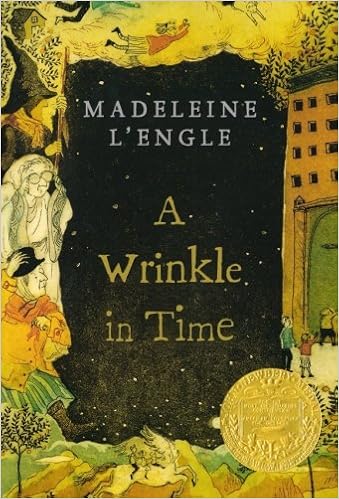
Outline: A Wrinkle in Time is the story of Meg Murry, a high-school-aged girl who is transported on an adventure through time and space alongisde her younger brother and her friend Calvin. Meg's father has been missing since his latest work on a secret project. They seek to rescue her father from the evil forces that hold him prisoner on another planet. To travel there and to prepare for the upcoming struggle that will secure their father's freedom, Meg and Charles seek out the help of three mysterious characters that refer to themselves as 'witches'. These creatures, Mr.s Whatsit, Mrs. Who, and Mrs. Which, reassure Meg of the existence of a tesseract, which is a sort of "wrinkle" in time and space. Through this wrinkle Meg and her companions travel through the fifth dimension in search of Meg's father.
With a story that strongly values independence, love, and embracing one's individuality, Meg goes from a homely and awkward girl plagued by personal insecurities and her concern for her father into a strong, independent, capable, and proud character.
Biography:
Having written her first book at the age of 5, Madeleine L'engle was a shy, clumsy child who was branded as stupid by some of her teachers. Unable to please them, she retreated into her own world of books and writing. Her parents often disagreed about hwo to raise her, and as aresult she attended a number of boarding schools and had many governesses. Traveling often as a family, the L'engles lived in Carolina, Florida, and the French alps. Madeleine attended Smith College in 1937 but did not publish Wrinkle until she was 40 years old as the novel had already been rejected 30 times by other publishers.
L'Engle was an Episcopalian and believed in universal salvation, writing that "All will be redeemed in God's fullness of time, all, not just the small portion of the population who have been given the grace to know and accept Christ. All the strayed and stolen sheep. All the little lost ones." As a result of her promotion of Christian universalism, many Christian bookstores refused to carry her books, which were also frequently banned from Christian schools and libraries. At the same time, some of her most secular critics attacked her work for being too religious.
Her views on divine punishment were similar to those of George MacDonald, who also had a large influence on her fictional work. She said "I cannot believe that God wants punishment to go on interminably any more than does a loving parent. The entire purpose of loving punishment is to teach, and it lasts only as long as is needed for the lesson. And the lesson is always love."
In 1982, L'Engle reflected on how suffering had taught her. She told how suffering a "lonely solitude" as a child taught her about the "world of the imagination" that enabled her to write for children. Later she suffered a "decade of failure" after her first books were published. It was a "bitter" experience, yet she wrote that she had "learned a lot of valuable lessons" that enabled her to persevere as a writer.
Rationale:
As a young reader, this was possibly my earliest exposure to sci-fi fantasy. I remember running out of books to read and finally pilfered my copy of Wrinkle out of my dad's old college books. As the main character is of high-school age, students should be able to easily relate to her. As I would most likely teach this novel with 9th graders, the themes of celebrating individuality and gaining self-confidence would fit well for their grade level and are concepts students of this age can almost universally relate to. While overt, the books themes and concepts are accessible while still remaining woven together into the narrative in such a manner that students would have good opportunity to be introduced to analyzing stories and arcs for thematic content and meaning. The messages present in this story promote personal growth and development and encourage empathetic action.
Teaching Ideas:
1. This book is filled with so many interesting and diverse characters that it can be used quite easily for students to practice character analysis and comparison, either in discussion or essay writing.
2. The main character Meg triumphs by embracing empathy and love for both others and herself. Students could apply the hero's journey arc to her and create a presentation showing how she ascribes to it.
3. Students can describe their "perfect world" in the form of a poem, short story, or drawing.
4. Students create character diagrams for each character that detail their physical and personality traits.
Age/Ability:
This novel would be introduced to 9th grade high school freshmen. The language is easily understandable but it does contain some scientific terms that may be unfamiliar to some audiences.
Obstacles:
This novel does contain moderately overt Christian imagery and themes. Some parents or students may take offense to reading a novel by a Christian author. As most of my teaching ideas focus on characterization, it is possible that I could choose a substitute book that follows the same patterns of character development like The Hobbit.The science fiction aspects of this story may not appeal to all students either, but the method in which it is introduced is in such as well that it should be accessible.
Comments
Post a Comment